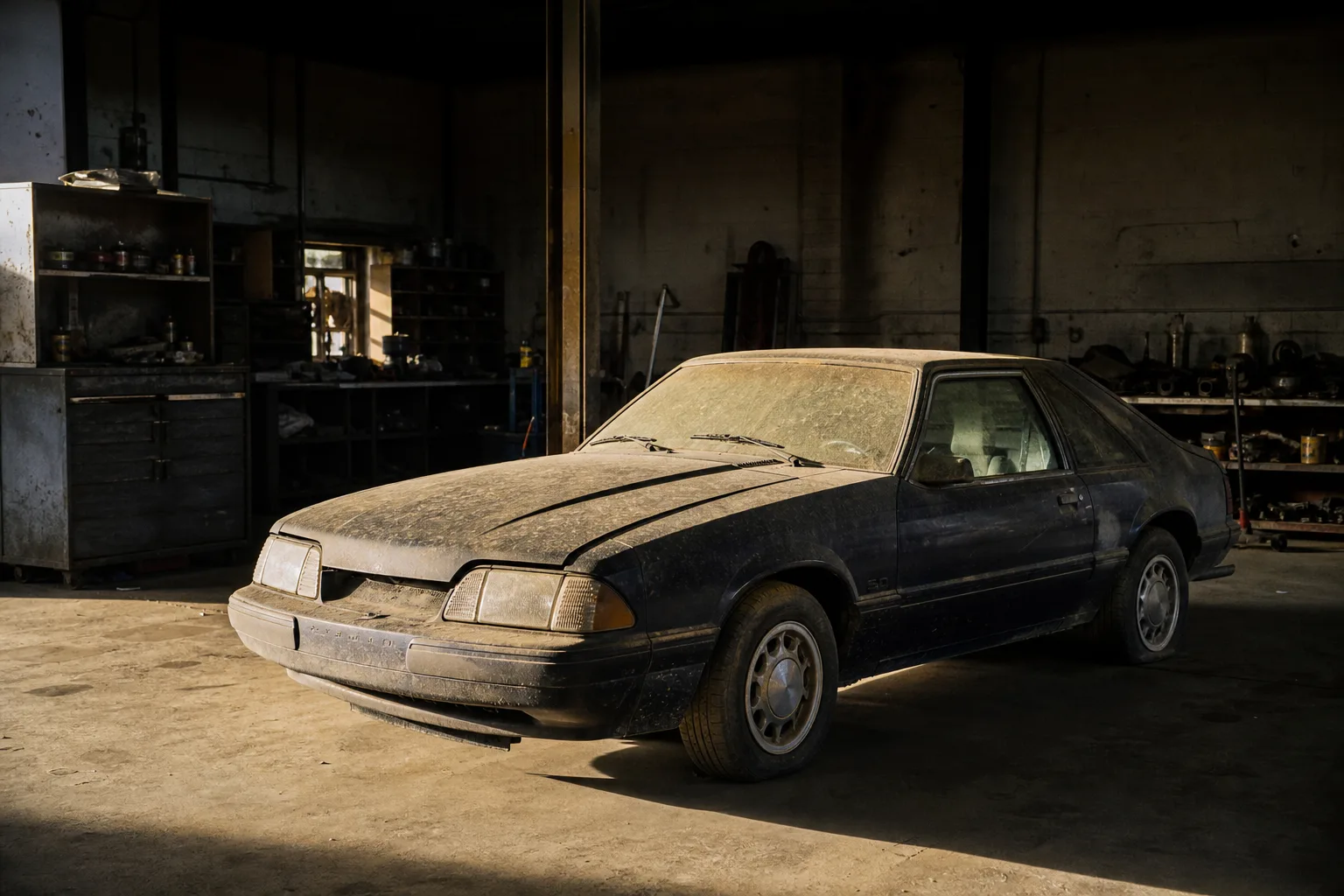
A certificate of title records a claim against a vehicle, not the vehicle itself, which is why a car can sit for decades with nobody legally able to sell it.
A 1962 saloon sat in a detached garage in Felton from the spring of 1991 until the estate sale in the fall of 2023, and every physical fact about it was easy to establish. The engine turned by hand. The VIN plate was intact, riveted, and legible. A folder in the glovebox held two smog certificates, a repair order from a shop in Scotts Valley, and the last registration card issued to the man who died in the house. What the folder did not hold was a certificate of title, and that single absence was worth more, in time and money, than everything the car needed mechanically.
The certificate records a claim, not the object
People treat a title as though it were a birth certificate for the car, a document confirming that the thing exists and is what it says it is. It does something narrower and more consequential. A certificate of title is the state's record of who holds the ownership interest in a described vehicle, along with any lien recorded against it, on the date the certificate issued. It proves nothing about condition, mileage beyond the disclosed figure, or whether the car is physically present anywhere. It is a claim, written down by a government office, and its whole value lies in being the most recent entry in an unbroken chain.
That distinction explains why a legible VIN does not help you much. The National Highway Traffic Safety Administration is responsible for the vehicle identification standards that make the number unique and readable, so the car can always be identified. Identification is not ownership. A DMV clerk can confirm the VIN corresponds to a real 1962 vehicle and still have no authority to hand the ownership interest to the person standing at the counter, because the record shows it sitting with someone else, or with someone's estate, or with a finance company that dissolved before the reader was born.
Registration and a bill of sale do different jobs
Registration is permission to operate on public roads for a defined period, paid for annually, tied to insurance and emissions compliance in most states. It lapses without affecting ownership at all. The registration card in that Felton glovebox expired in 1992 and was still perfectly accurate about who owned the car in 1992, which is precisely why it was useless in 2023. A bill of sale is a private contract between two people, evidence that money changed hands and that the seller intended to convey whatever interest he had. If he had no clear interest, he conveyed none, and a signature does not manufacture one.
Real estate solved this problem a century ago by inserting a professional between the parties. A buyer closing on a house does not accept the seller's word about the chain of ownership; a Title Agency searches the recorded history, identifies the encumbrances, and issues a policy backing the result with money. Vehicles have no equivalent private layer. The state motor vehicle department is the registry, the searcher, and the insurer of last resort, all at once, and it will not act on a claim it cannot trace back to its own prior entry.
How a car becomes unsellable while sitting still
The Felton car was not abandoned or hidden. Its owner simply stopped driving it, stopped renewing the registration, and kept the keys. Somewhere in the intervening decades the paper title went into a box, a drawer, or a landfill. When he died, the ownership interest passed to his estate, which meant the person entitled to sign was an executor who had not yet been appointed, transferring a car nobody had listed in the inventory. Meanwhile the state's record went stale: the address on file was thirty years old, and the file itself, in many states, is purged or archived after long inactivity.
Stack those conditions and you get a vehicle that is physically available and legally frozen. A buyer can pay for it, load it on a trailer, and store it indefinitely, and still be unable to register it, insure it properly, or resell it to anyone who cares about paperwork. Cars in that condition change hands for years on handshake terms among people who never intend to drive them on a road, which is exactly how the chain gets one link longer and one degree harder to repair each time.
What each route out actually costs
Three doors exist, and they are priced very differently. A duplicate title is the cheap one, available when the record still shows the seller as owner and the seller is alive and cooperative: a modest state fee, a form, and a wait measured in weeks. A bonded title is the middle door, used when ownership is provable but the paper is gone. States that offer it typically require an appraisal or valuation, then a surety bond written at a multiple of that value, often one and a half times, for which the reader pays a premium rather than the face amount. The bond sits open for a set period, three or five years in most states, during which a competing claimant can make a claim against it.
The expensive door is a court order, and some states, notably those that do not issue bonded titles at all, make it the only door. A quiet title action means filing a civil complaint, serving the last recorded owner or publishing notice when service fails, and appearing before a judge who signs an order directing the DMV to issue. Attorney time is the real cost, and it does not scale to the value of the car, which is why a five-figure legal bill on a car worth less is a genuine outcome. Deciding early which door applies is the single choice that determines the number.
The Felton car went the bonded route, because California offers it and the estate could produce enough evidence of the purchase to satisfy the review. Total outlay was a fraction of a quiet title action and took two counter visits plus one mailed correction. The car now has a clean record in its new owner's name, and the thirty-two-year gap has closed for good.